
Expansion of Dock innovation hub taking shape at Space City Leicester
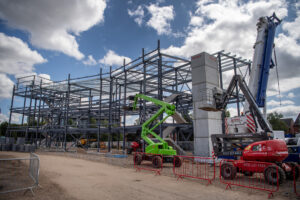
An ambitious expansion of an innovative workspace development for high-tech industries at the heart of Space City Leicester is starting to take shape.
Leicester City Council is expanding its existing Dock and Dock 2 workspace hub with two new Dock-style office buildings and a terrace of high-quality manufacturing spaces. Leicester City Council has appointed Leicester firm Brackley Property Developments (BPD) as its development partner for this exciting project.
The steel frame of the first of the new buildings is now in place, with construction of the entire scheme due to be complete by spring 2024.
The two new offices will provide space for up to 45 businesses across 4,000sqm, with the purpose-built industrial units providing an additional 2,000sqm of workspace across nine units.
A range of energy efficiency measures will mean the new buildings will be net carbon zero. These include roof-mounted photovoltaic panels, air source heat pumps, super insulation, and low-energy LED lighting. The new buildings will require no gas heating. Twelve chargers will also be installed for electric vehicles in a new parking area.
The new buildings have been designed to complement the look and feel of the original Dock workspace buildings which they are being built next to.
Once complete, the new buildings will become part of an expanded Dock campus, which is managed by the city council. The existing Dock buildings are home to around 50 businesses, with 90 per cent of the available workspaces currently occupied.
The £16.5million project is supported by £13million from the Government’s Levelling Up Fund. The Leicester and Leicestershire Enterprise Partnership (LLEP) is also providing £3.5million towards the project from Enterprise Zone retained business rates.
The new development is part of Space City Leicester, one of the largest and most connected Enterprise Zones for space-related activities in the UK. It will be home to space research, production, manufacture and development as well as non-space related knowledge economy businesses, those working towards decarbonisation, innovative start-ups and established businesses looking for grow on space.
Leicester City Mayor Sir Peter Soulsby said: “It’s fantastic to see the next chapter of our innovative workspace development for hi-tech businesses taking shape.
“Space City Leicester is helping to put our city firmly on the map for research, production and manufacture in the space industry.
“We’re proud to contribute to that momentum by further expanding our Dock innovation hub with three new, low carbon buildings which will help meet demand from businesses keen to locate here from the UK and overseas. The new buildings will also provide valuable grow-on space and much-needed manufacturing facilities for our local talent and high-tech entrepreneurs.”
Andy Reed OBE, LLEP Co-Chair, said: “Investing in creating a sustainable ecosystem for regional businesses is at the heart of our Economic Growth Strategy.
“The high occupancy rate at the existing Dock buildings gives us great confidence that dozens more exciting new businesses will move into these new energy-efficient workspaces when they open next year.”
The Space City Leicester partnership includes Space Park Leicester, University of Leicester, National Space Centre, Leicester City Council, and the Leicester and Leicestershire Enterprise Partnership (LLEP). Space City Leicester is part of the Loughborough and Leicester Science and Innovation Enterprise Zone.
Leicester City Council has appointed Leicester firm Brackley Property Developments (BPD) as its development partner for the Dock expansion project. Construction work is being carried out by county-based Wilton Construction Ltd.
Stephen Pedrick-Moyle, managing director of BPD, said: “We are delighted to be involved in the next phase of development at the National Space Park, following our delivery of the successful Dock 2 building. This purpose-built space will promote further business growth in the region and has the potential to support many jobs.”
<< Back